Publushed 05/10/2024
Time to read 7 minutes
Friendly Fraud vs. Malicious Fraud: The Two Faces of Chargeback Abuse
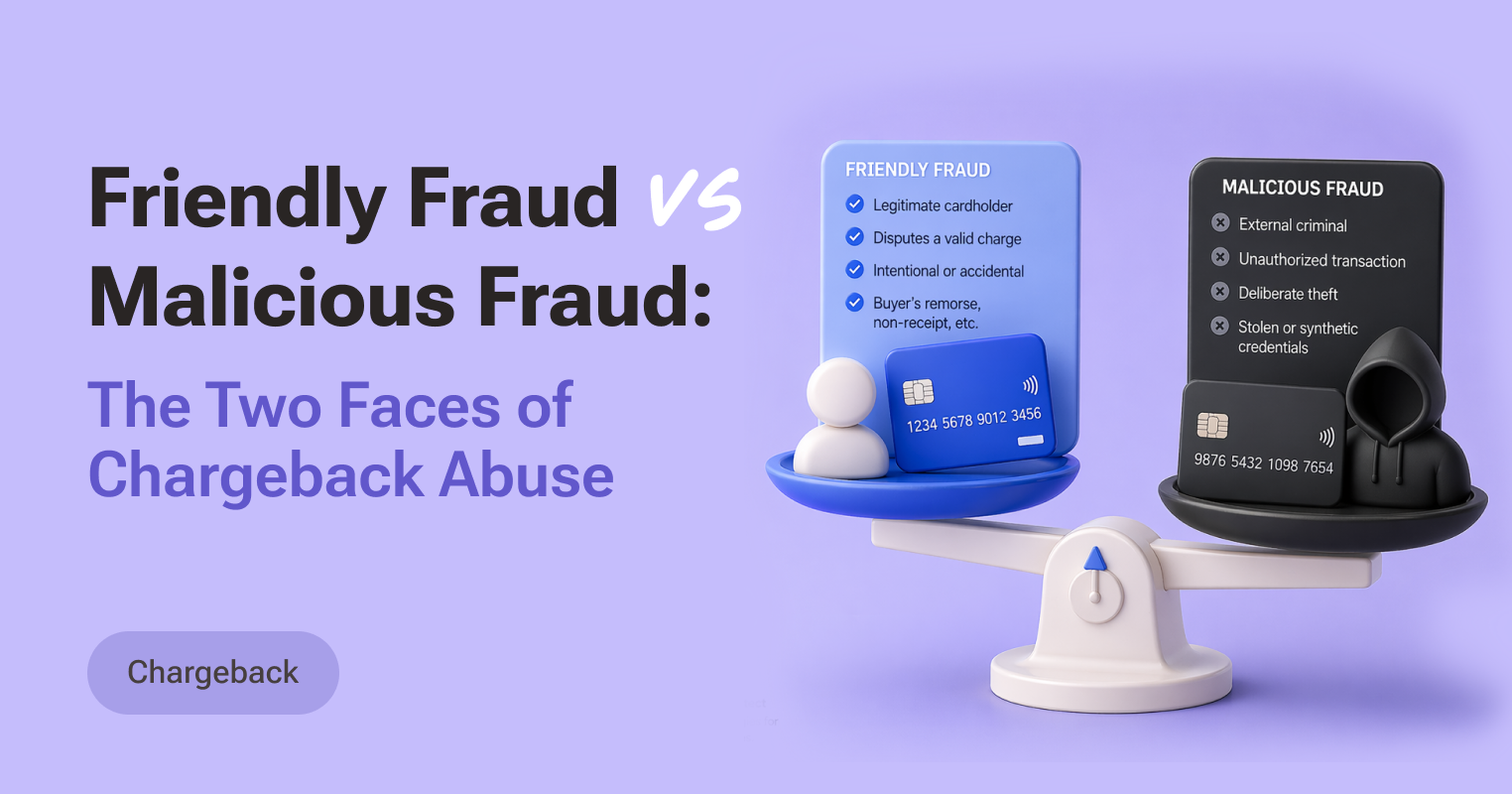
At the surface, both friendly fraud and malicious fraud end with a disputed charge and a debit to the merchant. Below the surface, however, the two phenomena differ in perpetrator, intent, evidence burden, legal implications, and long-term mitigation strategy.
Malicious fraud — also called true fraud or criminal fraud — involves an external criminal who steals or fabricates payment credentials to make an unauthorized purchase. Friendly fraud — also called first-party misuse or chargeback abuse — is initiated by the legitimate cardholder who disputes a purchase they themselves authorized. While both cost merchants billions, they require diametrically different prevention and dispute tactics.
Definitions and Core Distinctions
Malicious / True / Criminal Fraud
- Definition: A fraudster uses stolen or synthetic identity data to transact without the cardholder's consent.
- Perpetrator: External attacker — hacker, skimmer, phisher, dark-web reseller.
- Intent: Deliberate theft and monetization of goods or cash.
- Victim: Cardholder first, then the merchant when the chargeback lands.
- Typical Tools: Phishing kits, card skimmers, account-takeover bots, synthetic identity farms.
Friendly / First-Party Fraud
- Definition: A cardholder disputes a legitimate charge, claiming non-receipt, defect, or non-authorization.
- Perpetrator: The very customer who placed the order.
- Intent spectrum: Accidental (forgetting a subscription, failing to recognize a billing descriptor) to deliberate (buyer's remorse, free-trial abuse, gaming the return window).
- Victim: Merchant almost exclusively — the cardholder often keeps the goods.
Real-World Examples
Malicious Fraud Case
A cyber-criminal gang deploys phishing emails to harvest 4,000 credit-card numbers. They use an automated checkout bot to purchase gift cards from an electronics marketplace. The merchant blocks many orders shipping to a freight-forwarding hub, but 612 transactions still settle. The issuing bank files true-fraud chargebacks — merchant win rate is 8% due to lack of cardholder authorization evidence. Total loss: $183,000 in sales plus $42,000 in fees.
Friendly Fraud Case
A subscription box company sees a surge of "unrecognized charge" disputes six months after launch. Analysis shows 70% of the disputes come from customers who opened every shipment email and clicked tracking links — evidence of receipt. After updating billing descriptors and adding one-click "pause subscription" buttons, the chargeback ratio drops from 1.2% to 0.35% and win rate climbs to 58%, saving $1.1 million annually.
Operational Mechanics Side-by-Side
| Aspect | Malicious Fraud | Friendly Fraud |
|---|---|---|
| Point of Compromise | Data breach, phishing, skimming device | Cardholder's own wallet or browser |
| Transaction Appearance | High-velocity shipping to new address; device fingerprint mismatch | Looks 100% legitimate; AVS/CVV match |
| Discovery Timeline | Detected within hours by issuer fraud alerts | Surfaced weeks later via chargeback |
| Chargeback Reason Code | "No cardholder authorization" (true) | "Item not received," "Not as described," "Credit not processed" |
| Evidence Burden on Merchant | Prove the transaction was authorized (nearly impossible) | Prove the product was delivered or service consumed (achievable) |
| Merchant Win Rate | 9–12% | 40–65% when evidence is systematic |
Financial Impact
Malicious fraud caused $32 billion in global losses in 2024, mostly borne by issuers and merchants combined, plus ancillary costs like PCI investigations and brand-damage lawsuits.
Friendly fraud costs $25 billion annually in chargebacks and fees, with a 32% year-over-year growth rate in the U.S. market. Hidden costs include operational overhead from dispute teams, elevated chargeback ratios leading to higher processing rates or account termination, and inventory shrinkage.
Detection Signals
Malicious Fraud Red Flags
- Unusual geolocation, proxy IPs, device emulators.
- Rapid-fire small transactions (card testing).
- Shipping address divergent from billing address by more than 500 km.
Friendly Fraud Red Flags
- Post-delivery customer emails asking for free returns after deadline.
- Social-media posts showing the disputed item in use.
- Pattern of multiple chargebacks from same BIN or email domain without corresponding true fraud reports.
Prevention Playbooks
Malicious Fraud Mitigation
- Layered fraud-screening: CVV, 3D Secure 2.x, device fingerprinting, behavioral biometrics.
- Real-time velocity checks and geolocation rules.
- Tokenization and network-level risk scoring (Visa Advanced Authorization, Mastercard Decision Intelligence).
Friendly Fraud Mitigation
- Clear billing descriptors and pre-delivery email receipts.
- Delivery confirmation with photo or GPS stamp; signature capture for high-value orders.
- Self-service return portals and instant refund for low-risk customers.
- Chargeback alert networks (Verifi CDRN, Ethoca) to refund before the dispute matures.
- Post-purchase education: pop-ups that explain the difference between refunds and chargebacks.
Emerging Trends
On the malicious side, AI-generated deepfake voices are being used for social-engineering attacks on call centers, and Fraud-as-a-Service marketplaces sell "clean" identities that pass traditional KYC checks.
On the friendly fraud side, Visa CE3.0 now allows merchants to deflect disputes automatically by presenting prior undisputed transactions from the same card/device combination. Issuers are also piloting "merchant-first" chatbots that prompt cardholders to contact the merchant before initiating a chargeback.
Conclusion
Malicious fraud is an external siege; friendly fraud is an inside job. One demands stronger castle walls — tokenization, biometrics, and AI risk engines. The other requires better hospitality — clear signage, open doors, and quick refunds.
Merchants who conflate the two risk misallocating resources: over-investing in razor-thin fraud filters that block legitimate customers while under-investing in the post-purchase experience that could prevent a mistaken dispute. By mapping each chargeback to its correct root cause, the payments ecosystem can protect consumers from criminals without enabling consumers to become criminals themselves.
Share this post
Recommended articles
© 2026 Payments Lab Ltd. All rights reserved.
© 2026 Payments Lab Ltd. All rights reserved.